March 2, 2026
The University of Health and Allied Sciences (UHAS) has successfully hosted a three-day Intervention Design Workshop under the IMAGINE Ghana Project, bringing together national and international stakeholders to advance integrated care for Neglected Tropical Diseases (NTDs) and mental health conditions in Ghana.
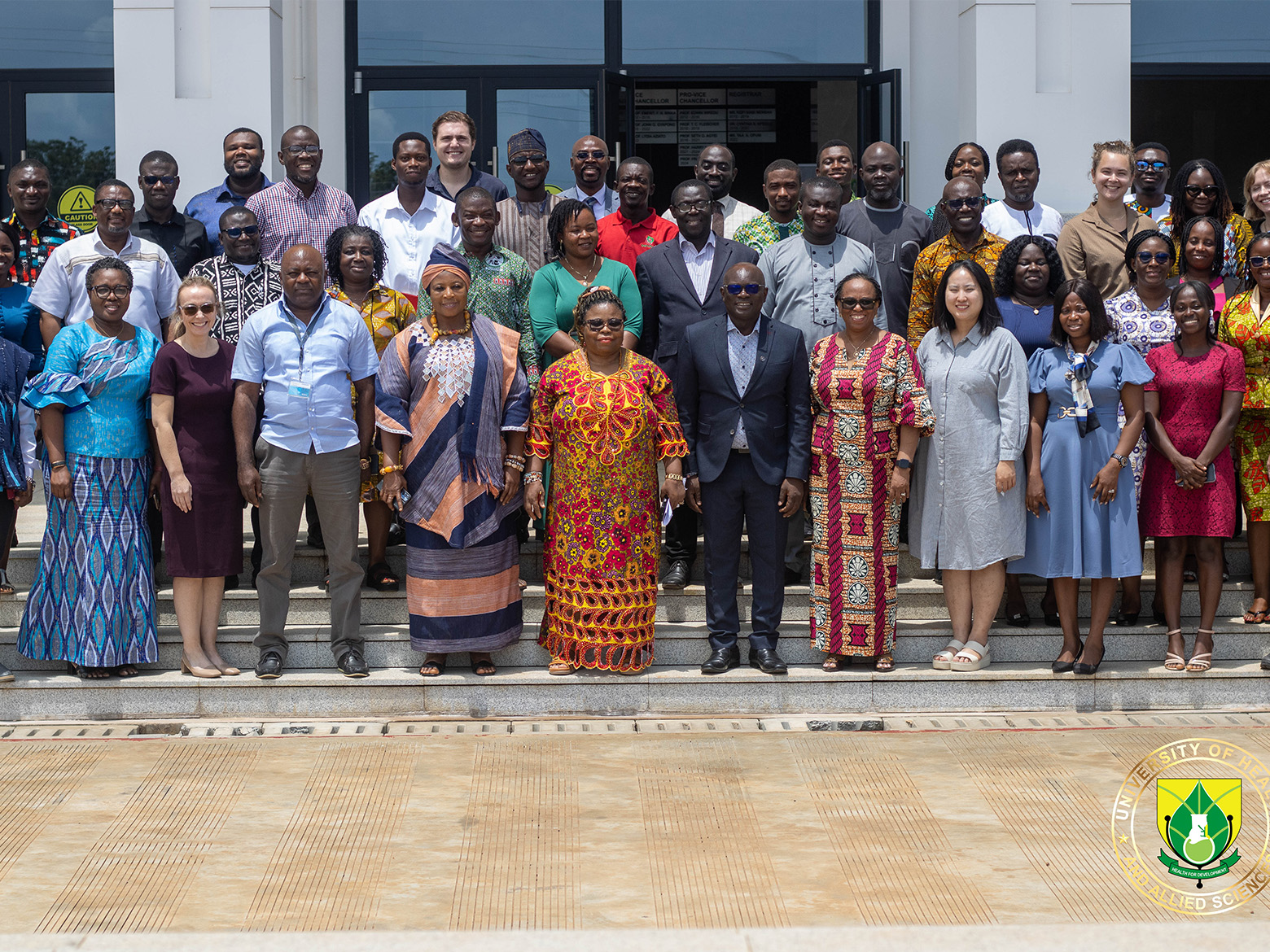
The workshop which was held from February 24 to 26, 2026 at the University’s main campus, convened researchers, policymakers, programme implementers, civil society organizations and affected persons to co-design context-appropriate interventions aimed at strengthening service delivery across all levels of the health system.
The primary objective of the workshop was to refine and adapt an Essential Care Package (ECP) that integrates NTD and mental health services within Ghana’s existing health delivery structures. Participants reviewed baseline findings organized by levels of the health system and identified critical gaps affecting service access, quality and coordination. The baseline included Ellembelle, Bole, Hohoe and Ho districts.
A photovoice exhibition further enriched discussions by presenting lived experiences from affected persons, grounding technical deliberations in community realities.
Using structured problem-solution tools and scoring matrices, participants prioritized gaps based on severity, population impact, feasibility within current capacity alignment with programme priorities and fit with existing NTD systems.
The three-day workshop combined plenary presentations, breakout group discussions and Steering Committee engagements.
The study is a four-year project being conducted by the Centre for Neglected Tropical Diseases Research (CNTDR) at UHAS Institute of Health Research (IHR), led by the Principal Investigator Dr. Alfred Manyeh
Miss Yaa Amankwa Opuni, the Registrar of the University and a representative of the Vice Chancellor on the first day of the workshop, affirmed UHAS’ commitment to advancing impactful research that responds to national health priorities. She commended partners and stakeholders for their collaboration under the IMAGINE Ghana Project and emphasized the importance of integrating mental health into NTD programming. She noted that evidence-informed interventions are critical to strengthening Ghana’s health system. The Registrar further encouraged sustained partnership, innovation and practical implementation of the workshop’s outcomes. She expressed confidence that the refined intervention package would contribute meaningfully to improving care for vulnerable populations.
Professor Lydia Aziato, the vice chancellor of the university who joined proceedings on the second day of the workshop emphasized the need for research to translate into tangible community-based interventions. She underscored the importance of communicating research findings in clear and accessible language to enhance understanding and uptake
The Director of UHAS-IHR Professor Alexander Manu, in course of the workshop, addressed the persistent challenge of stigma affecting persons living with NTDs and mental health conditions. He called for a shift from over-medicalization towards a more compassionate patient-centred model of care. He emphasized that attention must be given to caregivers who often experience depression and stigmatization. He noted that the initiative should not be seen merely as a project but a catalyst for change.
On the final day of the workshop, the Chairperson of the Steering Committee, Professor Evelyn Ansah in her concluding remarks, noted that the workshop was impactful. She stressed that persons living with NTDs require sustained support to access appropriate treatment and care. She urged stakeholders to ensure that strategies developed during the workshop are fully implemented.
The workshop brought together representatives from the Liverpool School of Tropical Medicine (LSTM), the ANESVAD Foundation and Effect Hope (TRANSFORM Project). The Ghanaian stakeholders included the Ghana Health Service (GHS), the Mental Health Authority, the Mental Health Department of GHS, National NTD Programmes, the Ministry of Environment, Science and Technology, Civil Society Organizations (CSOs) and representatives of persons affected by NTDs.
Neglected Tropical Diseases and mental health conditions continue to disproportionately affect vulnerable populations, often with overlapping social and economic consequences. By integrating mental health considerations into NTD programming, the IMAGINE Ghana Project seeks to promote more holistic, patient-centered and sustainable care models.
The successful hosting of the Intervention Design Workshop reinforces UHAS’ leadership in collaborative research and its role as a convener of multidisciplinary partnerships aimed at translating evidence into policy and practice. Through such initiatives, the University continues to contribute meaningfully to national and global efforts to strengthen resilient and inclusive health systems.